
How I use my voice as an HD patient advocate to create change
Advocacy is personal to me as a Black woman living with Huntington's
Written by |

There is something powerful about standing in a room and telling the truth about what it means to live with Huntington’s disease (HD). Every time I share my story, I am reminded that advocacy is not just about speaking. It is about being seen, making space, and helping change the way people understand this disease.
As a Black woman living with Huntington’s, that matters deeply to me. For too long, the public image of HD has been narrow. There is often an assumption that the disease mainly affects white families. That is simply not true. HD exists across races, cultures, and countries. We are everywhere. Yet when people don’t see themselves represented in educational materials, research conversations, advocacy campaigns, or patient stories, it can create the false impression that they do not belong in the HD community.
I know what it feels like to be questioned because I didn’t match someone else’s idea of what a person with Huntington’s should look like. I’ve been told that Black people don’t get HD. People have questioned whether my CAG repeat was high enough and whether my symptoms were typical enough. Experiences like that can make a person feel invisible. For me, they did the opposite. They made me more determined to use my voice.
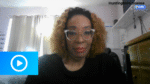
One of the most important truths I try to share is that Huntington’s doesn’t look the same in every person. Some people have more noticeable chorea. Others experience changes in cognition, mood, balance, speech, or behavior. Some symptoms are visible, while others are not. Even people in the same family can experience the disease differently.
That is why I challenge the idea that someone has to “look sick enough” to have HD.
Just because I can walk into a room independently, speak clearly, smile, laugh, travel, or participate in professional spaces does not mean I am not living with Huntington’s. My ability to articulate my thoughts does not erase my diagnosis. My symptoms are not less real because someone expected me to look different.
Why advocacy matters
This is where advocacy becomes deeply personal for me. Every time I speak at a conference, participate in a panel, meet with researchers, write a column, or tell my story to someone who has never met a Black person with HD, I feel like I am helping expand the picture of what this community looks like. I am reminding people that there is no single face of Huntington’s.
Advocacy has also helped me understand the value of lived experience. Researchers and clinicians bring essential knowledge, but people living with HD also bring a kind of expertise that can’t be learned from a textbook. We know what it feels like to live inside the diagnosis. We understand the fear of progression, the uncertainty, the family dynamics, the stigma, the genetic testing decisions, the caregiving responsibilities, and the emotional weight that can follow us into everyday life.
Our voices belong in conversations about research, healthcare, support services, education, and the future of treatment.
Becoming an advocate has empowered me because it gives me an active role in a disease that can sometimes make people feel powerless. There are many aspects of Huntington’s that I cannot control. I can’t control every symptom or know exactly what the future will bring. But I can control what I do with my voice today.
I can educate people who have never heard of HD. I can challenge stereotypes. I can ask difficult questions. I can point out when conversations are not inclusive. I can remind researchers that there are human beings behind the data. I can encourage other people living with HD to understand that their stories matter, too.
Advocacy does not mean I am never tired, anxious, frustrated, or symptomatic. There are days when living with this disease takes most of my energy. There are moments when I need rest more than I need a microphone. But advocacy has taught me that my voice doesn’t have to be perfect to be powerful.
I want people to understand that the HD community is diverse. We are Black, white, Latino, Asian, and members of communities all over the world. Our symptoms may present differently. Our family histories may be different. Our experiences with healthcare may not be the same. But every one of us deserves to be represented, respected, and heard.
As long as I can articulate my thoughts and tell my story, I am going to keep speaking my truth. Huntington’s is part of my life, but it doesn’t get to define the limits of my voice.
If anything, it has given me even more reason to use it.
Note: Huntington’s Disease News is strictly a news and information website about the disease. It does not provide medical advice, diagnosis, or treatment. This content is not intended to be a substitute for professional medical advice, diagnosis, or treatment. Always seek the advice of your physician or other qualified health provider with any questions you may have regarding a medical condition. Never disregard professional medical advice or delay in seeking it because of something you have read on this website. The opinions expressed in this column are not those of Huntington’s Disease News or its parent company, Bionews, and are intended to spark discussion about issues pertaining to Huntington’s disease.

Leave a comment
Fill in the required fields to post. Your email address will not be published.