
A new puppy gives my gene-positive wife a sense of purpose
Dexter adds joy and laughter to our life with Huntington's
Written by |

Breaking news: We have a new dog. He’s a puppy. His name is Dexter, and he’s perfect.
He’s perfect at eating little things that have accumulated on the floor of our home, such as dust balls, little scraps of paper, and tiny pieces of food. He’s perfect at walking so close to your feet that you trip (multiple times) over him. He’s perfect at being incredibly cute as he hugs you when you pick him up, whines when you leave the room, or falls asleep at the drop of a hat. We are rejoicing that we finally have a new dog.
As faithful readers of this column may recall, my wife, Jill, and I had a dog. Her name was Baby Girl, and she was the most beautiful cocker spaniel you’d ever met. But we had to put her down in 2022 because she was suffering from various ailments.

Love at first bite
For a while, Jill and I thought she’d be the last dog we would ever own. But Jill, who is gene-positive for Huntington’s disease, found herself missing a companion to keep her company during the day. As a result of her illness, she is no longer able to work, and staying at home during the day can get lonely.
We love cocker spaniels, so Jill decided to look for another one. Periodically, she would send me links that depicted cute photos of cockers who needed homes. Most of them were very expensive, and none felt right, until Jill came across something promising during a recent weekend. A website showed a photo of two brothers who were 7 weeks old. Part cocker spaniel and part rat terrier, both were incredibly adorable. They were rescue dogs, and they were affordable.
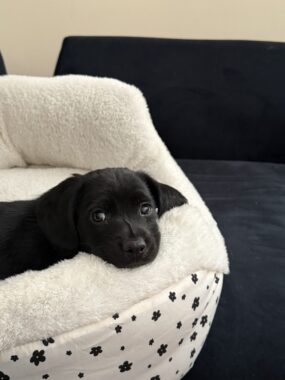
Our new puppy, Dexter. (Photo by Carlos Briceño)
Jill reached out, and we talked to the lady who had been fostering them. She said one of the brothers had been adopted, but the other one was still available. We drove an hour and a half to visit him on Martin Luther King Jr. Day, which I had off from work.
It was love at first bite. (He’s so young that he’s still teething.) He was smart. He was adorable. He was happy. His tail never stopped wagging. (Amazingly, it still hasn’t.)
We brought him home on Jan. 23. Dexter is still smart and adorable, and he’s even happier to have found a new home. Jill and I are over the moon with joy.
Having a dog gives Jill a sense of purpose. She looks forward to taking him on walks when he’s slightly older. Right now, she doesn’t have an excuse to take a walk when she’s at home during the day. Plus, Jill loves to take care of her loved ones, but we’ve been empty nesters for a while now. Our adult daughter, Alexus, is married and living in Boston with her husband. Jill “moms” her as often as she can, but it’s often long-distance. Jill now has a “little man” to mom, in person and every day.
Most importantly, Dexter makes us laugh. When you’re faced with a terminal illness like Huntington’s, it can be difficult to watch disease progression affect your life. The frequent dopamine hits that Dexter supplies are good for Jill — and for me.
Charles M. Schulz, the beloved creator of Snoopy and the comic strip “Peanuts,” said it best: “Happiness is a warm puppy.”
Jill and I completely agree.
Note: Huntington’s Disease News is strictly a news and information website about the disease. It does not provide medical advice, diagnosis, or treatment. This content is not intended to be a substitute for professional medical advice, diagnosis, or treatment. Always seek the advice of your physician or other qualified health provider with any questions you may have regarding a medical condition. Never disregard professional medical advice or delay in seeking it because of something you have read on this website. The opinions expressed in this column are not those of Huntington’s Disease News or its parent company, Bionews, and are intended to spark discussion about issues pertaining to Huntington’s disease.



Marion Franke
Dexter is so sweet.
😁