Guest Voice: We hold onto hope while fighting for new treatments
'There’s no community like the HD community'
Written by |

I met my husband, Nathan, in 2009, when his sister and one of my best friends from high school decided to set us up. I’d just gone through a breakup, and Nathan was going through a divorce. But the setup didn’t take.
Fast forward to a Christmas Eve party two years later. Nathan arrived late and greeted everyone, including me, with hugs. Just before I left, we had a chance to speak and take a photo together.
We had our first date the day after Christmas. He was late again, which I would come to learn was a common occurrence. We saw a movie and got coffee before he went to work. When we got back to his car, the battery had died, so I ended up taking him.
I recall dropping him off and thinking, “We can be friends.” But it surprised me when I also thought, “I can’t wait to see him again.”
Little did I realize that night would change my life in more ways than I would ever know.

A journey that is our own
We quickly became friends who loved to talk and use twisted humor with everything. We dated for almost two years and then got married two months before our second anniversary.
I knew that Nathan’s mom had died of a rare disease no one had ever heard about, and that Nathan could have the same disease. I still wanted to marry him.
We’d been married for over two years, had a surprise baby, and were living life when everything changed again. Like his mom, Nathan was diagnosed with Huntington’s disease (HD).
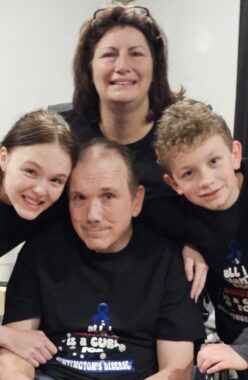
Clockwise from front, Nathan Wilmoth, Gabrielle Wilmoth, Heather Thurgood Wilmoth, and Haden Wilmoth wear their 2025 Christmas wish on their shirts: “All I Want for Christmas is Huntington’s cure.” (Courtesy of Heather Thurgood Wilmoth)
I recall telling the genetic counselor, “Well, I guess it’s a good thing we married later in life. We’ll die together.” It was twisted humor to mask my fear and the feeling of a 100-pound kettlebell in my stomach.
To say we were devastated is an understatement. We had the mindset that Nathan was going to die soon. Even with that death sentence, I told Nathan, “Your walk with Huntington’s won’t be your mom’s. Mine won’t be your dad’s.”
Our local neurologist gave us information on a research collaboration called Enroll-HD. At our first appointment, we met another neurologist who exuded positivity, and the Heather and Nathan that walked out weren’t the same ones who walked in.
We began raising awareness about a rare disease that was rarely discussed. We shared our journey with HD, including our participation in clinical trials and observational studies, as well as our daily life.
I was never the advocate type before this and would’ve once thought the idea insane. But now, I have a standard advocacy speech to explain the disease that’s robbing my husband of his abilities to speak, walk, and all of the other normal things healthy people take for granted.
In 2024, an HD organization invited Nathan to be a panelist in a patient listening session with the U.S. Food and Drug Administration (FDA), where we shared our story.
We explained how we felt the medical community was giving up on people like Nathan. We talked about sharing our lives on social media to show that mid-to-late-stage patients aren’t alone and that HD community members can still have a quality of life.
We shared that our oldest child from Nathan’s first marriage had been diagnosed a couple of months earlier, and our youngest is considered at risk.
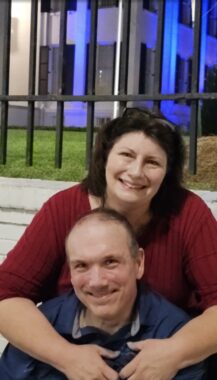
In May 2025, Heather Thurgood Wilmoth and her husband, Nathan, pose before the governor’s mansion in Mississippi, which was lit with blue lights to raise awareness about Huntington’s disease. (Courtesy of Heather Thurgood Wilmoth)
When Nathan was diagnosed, few pharmaceutical companies were seeking a treatment for HD. Now, there are many, including uniQure, which was expected to submit a biologics license application to the FDA for its investigational gene therapy, AMT-130, early this year. Unfortunately, the FDA decided in late 2025 not to move forward with the approval process, citing insufficient clinical data.
Even at Nathan’s stage of the disease, we’d be happy if the progression could be slowed or stopped. But we also have two children, and friends in the HD community who are like family to us, and we want this potential treatment to become available to them, too.
When our oldest daughter told us she had inherited HD, I once again said, “Your walk with Huntington’s won’t be your dad’s.”
Our community still hangs onto hope. And now we have a potential treatment that we unfortunately can’t access. But it’s a start.
There are petitions in support of AMT-130 receiving a fair review, and five major HD organizations have joined to create templates for people to write to federal lawmakers to build support.
In the Huntington’s world, we may not have a lot, but we do have hope. At that first Enroll-HD appointment, our doctor told us, “There’s no community like the HD community.” That observation was accurate.
To submit your own Guest Voice for publication on Huntington’s Disease News, please email your idea to our columns manager at [email protected] with the following included in the subject line: “Guest Voice: Huntington’s Disease News.”
Note: Huntington’s Disease News is strictly a news and information website about the disease. It does not provide medical advice, diagnosis, or treatment. This content is not intended to be a substitute for professional medical advice, diagnosis, or treatment. Always seek the advice of your physician or other qualified health provider with any questions you may have regarding a medical condition. Never disregard professional medical advice or delay in seeking it because of something you have read on this website. The opinions expressed in this column are not those of Huntington’s Disease News or its parent company, Bionews, and are intended to spark discussion about issues pertaining to Huntington’s disease.